LIB · IV Hugo Münsterberg, 1913
Psicología y eficiencia industrialPsychology and Industrial Efficiency
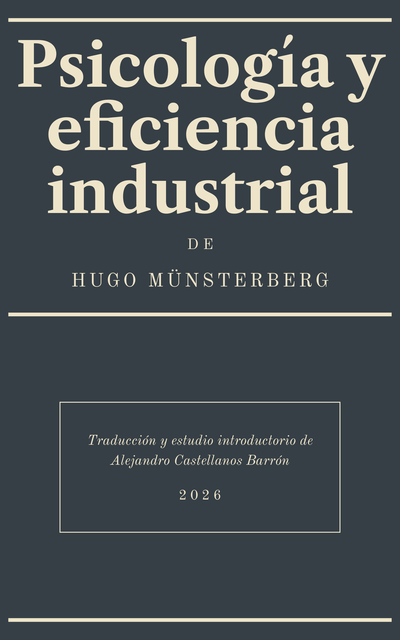
Edición digitalDigital edition
El ZIP trae el libro completo en dos formatos: EPUB para lectores electrónicos y PDF para leer en pantalla o imprimir.
The ZIP contains the complete book in two formats: EPUB for e-readers and PDF to read on screen or print.
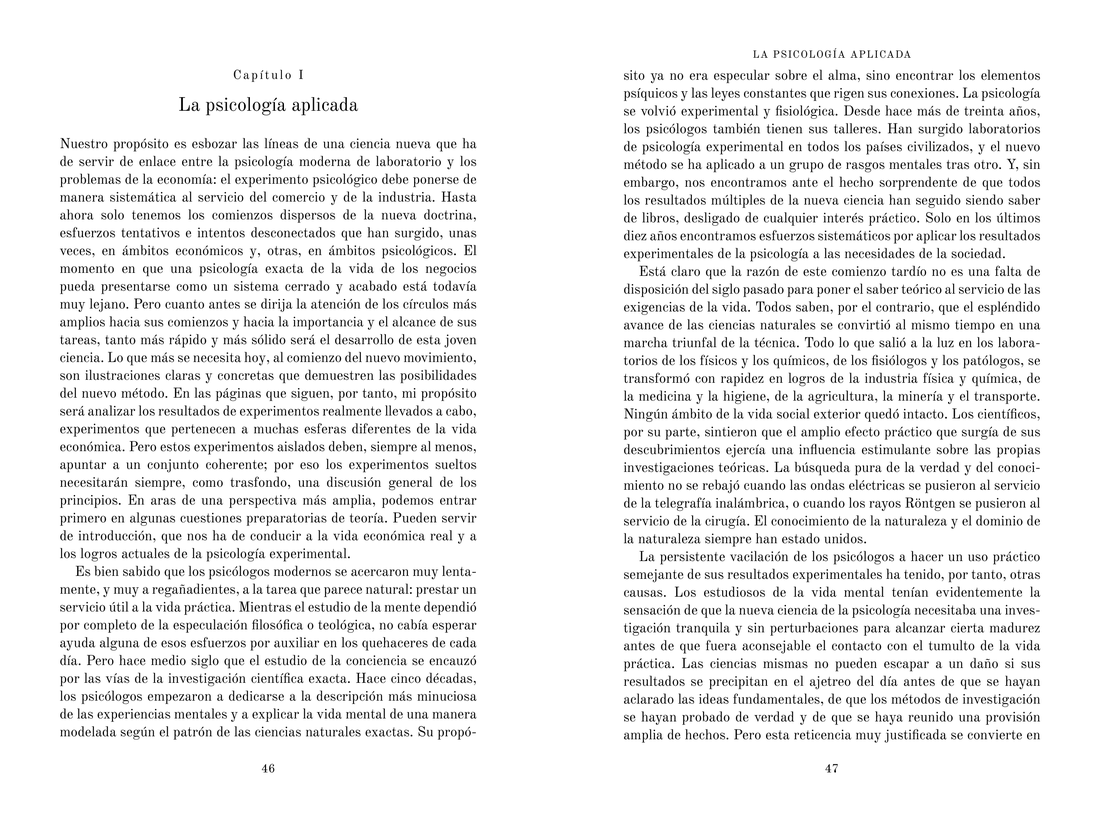
Edición digitalDigital edition
El libro completo en español, con estudio introductorio y notas.
The complete book in Spanish, with introductory study and notes.
- ZIP con un EPUB y un PDF.A ZIP with one EPUB and one PDF.
- PDF de 227 páginas, hoja de 6 por 9 pulgadas, con índice, vínculos internos y marcadores.227-page PDF, 6 by 9 inch page, with a table of contents, internal links and bookmarks.
- El libro está en español.The book is in Spanish.
Pago con tarjeta en la página de Polar, que te envía el recibo. Descargas los archivos en cuanto se confirma el pago.
Card payment on Polar’s checkout page, which sends you the receipt. You download the files as soon as the payment is confirmed.
Hugo Münsterberg (1863-1916) fue un psicólogo alemán que enseñó en Harvard y dirigió allí el laboratorio de psicología. En este libro, publicado en 1913, propuso una ciencia nueva, la psicotecnia, para llevar el experimento psicológico a la empresa: encontrar al hombre apto para cada puesto, descubrir en qué condiciones rinde el trabajador y estudiar cómo producir efectos en la mente de los compradores. Sus tres partes llevan por título «El mejor hombre posible», «El mejor trabajo posible» y «El mejor efecto posible». Los argumentos se apoyan en experimentos con motoristas de tranvía, oficiales de barco y telefonistas, y en experimentos sobre la monotonía, la atención y los anuncios.
Hugo Münsterberg (1863-1916) was a German psychologist who taught at Harvard and directed its psychology laboratory. In this book, published in 1913, he proposed a new science, psychotechnics, to bring the psychological experiment into business: finding the right man for each job, discovering the conditions under which the worker performs best, and studying how to produce effects in the minds of buyers. Its three parts are titled “The Best Possible Man,” “The Best Possible Work” and “The Best Possible Effect.” His arguments rest on experiments with streetcar motormen, ship officers and telephone operators, and on experiments on monotony, attention and advertisements.
Esta edición traduce Psychology and Industrial Efficiency (Boston y Nueva York, Houghton Mifflin, 1913; dominio público): el libro completo, con sus tres partes y sus veinticuatro capítulos y con las notas del autor. Un estudio introductorio sitúa el libro en su época, lo compara con la administración científica de Taylor, recoge cómo lo recibieron sus contemporáneos y lo lee desde los riesgos psicosociales del trabajo que hoy se estudian. Traducción, notas y estudio de Alejandro Castellanos Barrón (2026).
This edition translates Psychology and Industrial Efficiency (Boston and New York, Houghton Mifflin, 1913; public domain): the complete book, with its three parts and twenty-four chapters and the author’s notes. An introductory study places the book in its time, compares it with Taylor’s scientific management, tells how his contemporaries received it and reads it in light of the psychosocial risks at work studied today. The edition is in Spanish. Translation, notes and study by Alejandro Castellanos Barrón (2026).
Cómo se hizoHow it was made
La traducción, las notas del traductor y el estudio introductorio se prepararon con ayuda de inteligencia artificial, siguiendo un método de traducción y un glosario escritos para esta edición. El editor, Alejandro Castellanos Barrón, tomó las decisiones de criterio que explica la nota editorial.
The translation, the translator’s notes and the introductory study were prepared with the help of artificial intelligence, following a translation method and a glossary written for this edition. The editor, Alejandro Castellanos Barrón, made the judgment calls explained in the editorial note.
El texto inglés se tomó del reconocimiento automático de caracteres de un ejemplar digitalizado de la Universidad de Toronto que conserva Internet Archive, se cotejó con otro de la Universidad de California en Los Ángeles y se corrigió contra las imágenes de las páginas.
The English text was taken from the automatic character recognition of a digitized copy from the University of Toronto held by Internet Archive, checked against another from the University of California, Los Angeles, and corrected against the page images.
Cómo abrir los archivosHow to open the files
EPUB: en Apple Books, Google Play Libros, Kobo, Thorium Reader o Calibre. PDF: en cualquier lector de PDF. Los archivos no tienen DRM y son para tu uso personal: no se permite redistribuirlos ni revenderlos.
EPUB: in Apple Books, Google Play Books, Kobo, Thorium Reader or Calibre. PDF: in any PDF reader. The files have no DRM and are for your personal use: they may not be redistributed or resold.